
Best AI Dating Simulator Apps in 2026 (And How They Differ from Dating Sims)
The best AI dating simulator apps in 2026, how they actually work, how they compare to classic visual-novel dating sims, and whether they're worth trying over a real dating app.

Marco Vega
Tech Reviewer
The short answer: the best "AI dating simulator" experiences in 2026 aren't games. They're AI companion apps with strong roleplay and scenario systems. Kissable is the best overall (an open-ended relationship plus 20+ structured interactive scenarios with side characters, the closest thing to a dating sim with no script rails). Character.ai is the best free option for pure roleplay variety, and Kindroid is best if you want to author your own romance storyline. Classic choice-based dating sims still exist, but once you've had a love interest who improvises and remembers, picking dialogue option B from a menu feels like a flip phone.
_Last updated: September 10, 2026_
TL;DR: Top Picks at a Glance
- Best overall: Kissable, for structured scenarios with side characters on top of a relationship that remembers you.
- Best free: Character.ai, for the sheer volume of user-made dating scenarios.
- Best for writers: Kindroid, if you want to author the character and the premise yourself.
- Best slow burn: Nomi, for open-ended romance with no scenario scaffolding at all.
- The thing that actually changed: there is no dialogue menu any more. You type whatever you want.
What is an AI dating simulator, exactly?
The term covers two very different things, and knowing which one you want saves you a bad download:
Classic dating sims are games: visual novels with drawn characters, scripted routes, and dialogue menus. Every player gets the same story branches. Fun, finite, zero improvisation.
AI dating simulators replace the script with a language model. The love interest generates responses live, remembers what you said, and the "route" is whatever the two of you build. There's no ending screen because there's no script. It's a relationship simulation, not a story with a fail state.
Nearly everyone searching "AI dating simulator" in 2026 wants the second kind, so that's what this guide ranks.
Classic dating sims vs AI dating sims: what actually changed
One thing changed, and everything else follows from it: the dialogue menu is gone.
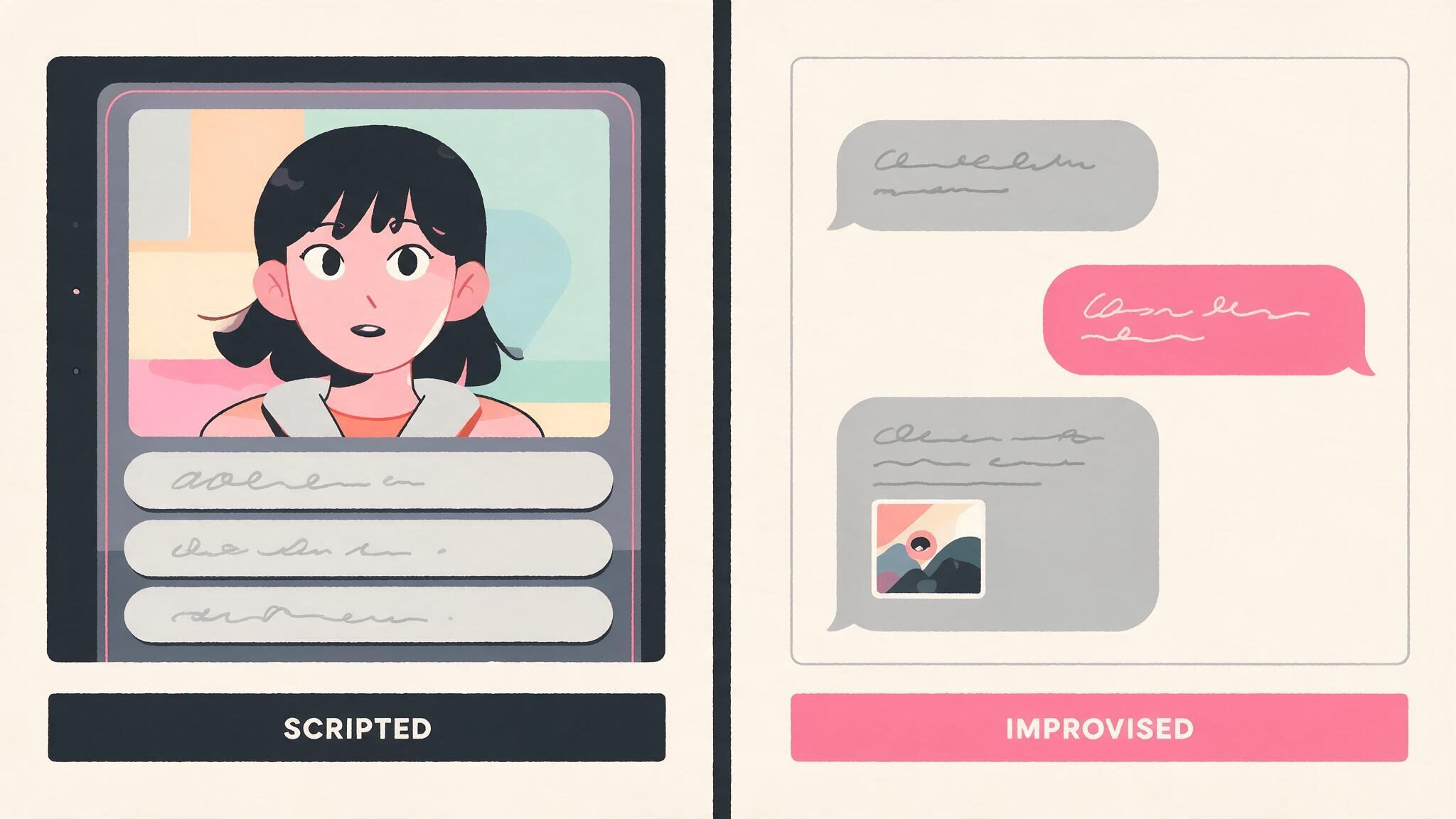
In a classic dating sim you are choosing. Doki Doki Literature Club has four girls and a fixed set of poems. HuniePop has a stat system and a puzzle board. Emily is Away gives you dialogue options that rewrite themselves as you hover, which was a genuinely clever trick precisely because it was a trick: the script knew every branch in advance. Even the enormous ones, Katawa Shoujo and the Nekopara series, are finite trees. A studio wrote every line you will ever read before you installed the game.
That constraint bought you things worth having, and it's why people still play them:
- Authored quality. Every line was written and edited by a person who cared. AI dialogue is more responsive and less well written, and anyone who tells you otherwise is selling something.
- Real endings. A route resolves. You get closure, credits, a sense of having completed a thing.
- Art direction. Hand-drawn characters with a consistent style, rather than generated images with the occasional wrong hand.
- It ends. You finish it and move on. This is a feature.
What an AI dating sim trades all of that for is improvisation. You type "I'd rather not talk about my dad tonight" and it lands, because nobody had to anticipate it. A memory system may carry that preference into later conversations, though recall can fail. You can take the story somewhere the writers would never have gone, which is either the entire point or a loss of authorial control, depending on what you came for.
| Classic dating sim | AI dating simulator | |
|---|---|---|
| Input | Pick from 2 to 4 options | Type anything |
| Writing quality | Authored and edited | Generated, uneven |
| Replay value | Different authored routes | Variable generated responses |
| Memory | Flags and variables | Depends on the app’s retention and retrieval |
| Art | Hand drawn, consistent | Generated per scene |
| Ending | Often authored endings | Can be open-ended or bounded by a scenario |
| Cost | Varies by game | Varies by app, plan, and media use |
The honest recommendation: if you want a story, play a good visual novel. If you want a relationship simulation where the other person surprises you, that is what the apps below are for. They are not the same craving.
How do AI dating simulator apps work?
Three layers, stacked:
- A language model plays the character. Personality, mood, flirting, conflict, all generated in real time rather than pulled from a script tree.
- Memory makes it a relationship. Good apps log your history (names, dates, running jokes) so the simulation compounds instead of resetting. Weak memory is the #1 way these apps break; it's the feature to check first.
- Scenario systems add the "sim" structure. The best apps layer optional structured experiences (a date night, a mystery, a trip) on top of the open-ended relationship, with settings and side characters, so you get story shape without losing improvisation.

The best AI dating simulator apps in 2026
| App | Best for | Structure | Price |
|---|---|---|---|
| Kissable | Full relationship + structured scenarios | 20+ interactive scenarios, NPCs, auto-generated scene art | Free to start; $14.99/mo |
| Character.ai | Free roleplay variety | User-created scenario bots | Free (ads) / $9.99 c.ai+ |
| Kindroid | Authoring your own storyline | 2,000-char backstories, group chats | $13.99/mo |
| Nomi.ai | Slow-burn realistic romance | Open-ended, strong memory | $15.99/mo |
Kissable is our app, and the one that most literally earns the "simulator" label: alongside the open-ended relationship you get 20+ interactive scenarios (dates, adventures, mysteries) with side characters, lorebook world-building, and background art generated per scene. Your companion carries memories between the scenario and everyday chat, which is the detail scripted sims can't do: the beach-trip storyline gets referenced in Tuesday's ordinary conversation. Romance progresses through natural relationship stages, and photos and voice give the dates texture. Free to start, no credit card.
Character.ai has the biggest library of dating-sim-style scenarios anywhere, all user-created and free. The trade-offs are the usual ones: short memory means your romance resets its own continuity, and the filter interrupts anything that gets too heated.
Kindroid is the writer's option. You author the character and premise in detail, and the model plays it consistently; group chats allow multi-character storylines. No packaged scenarios, so the sim structure is on you.
Nomi has no scenario system to speak of, but it's the strongest pure slow-burn: long-form conversation and memory good enough that the "storyline" emerges on its own.
What an AI dating sim actually looks like when you play it
_The images in this section are crops from Kissable’s App Store marketing screenshots, prepared in August 2026. They show example scenes, not an independent comparison test._
It looks like a story browser and then, inside a story, something between a visual novel and a text conversation. Scenarios sit in a library with the one you're mid-way through pinned at the top.
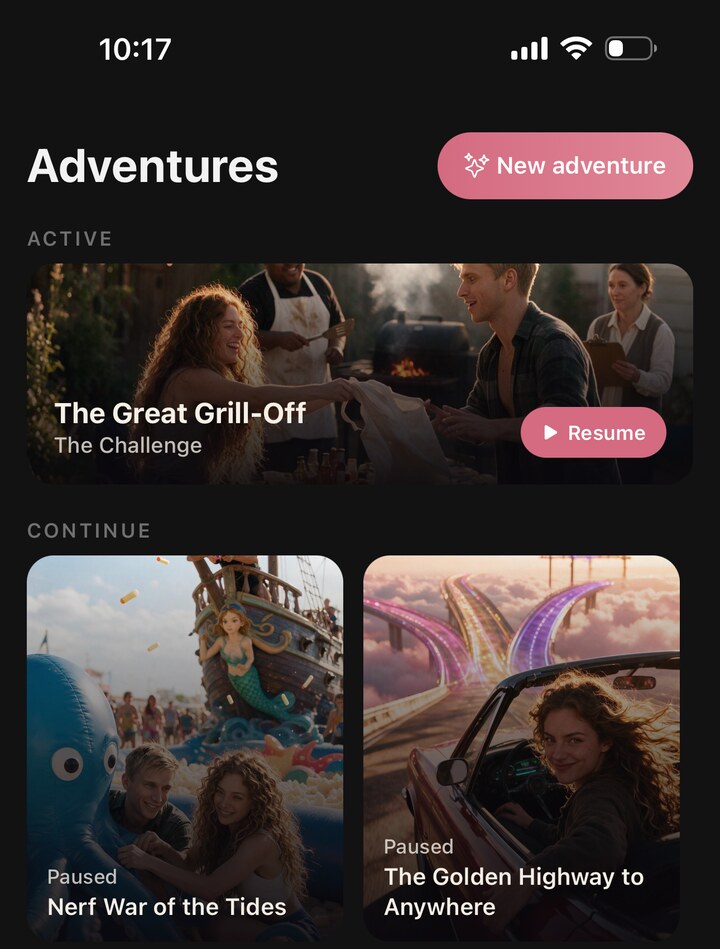
Open one and you get a scene image, narration in prose, and dialogue from characters who are not your love interest. Side characters have their own names, avatars and colours, and they push back.
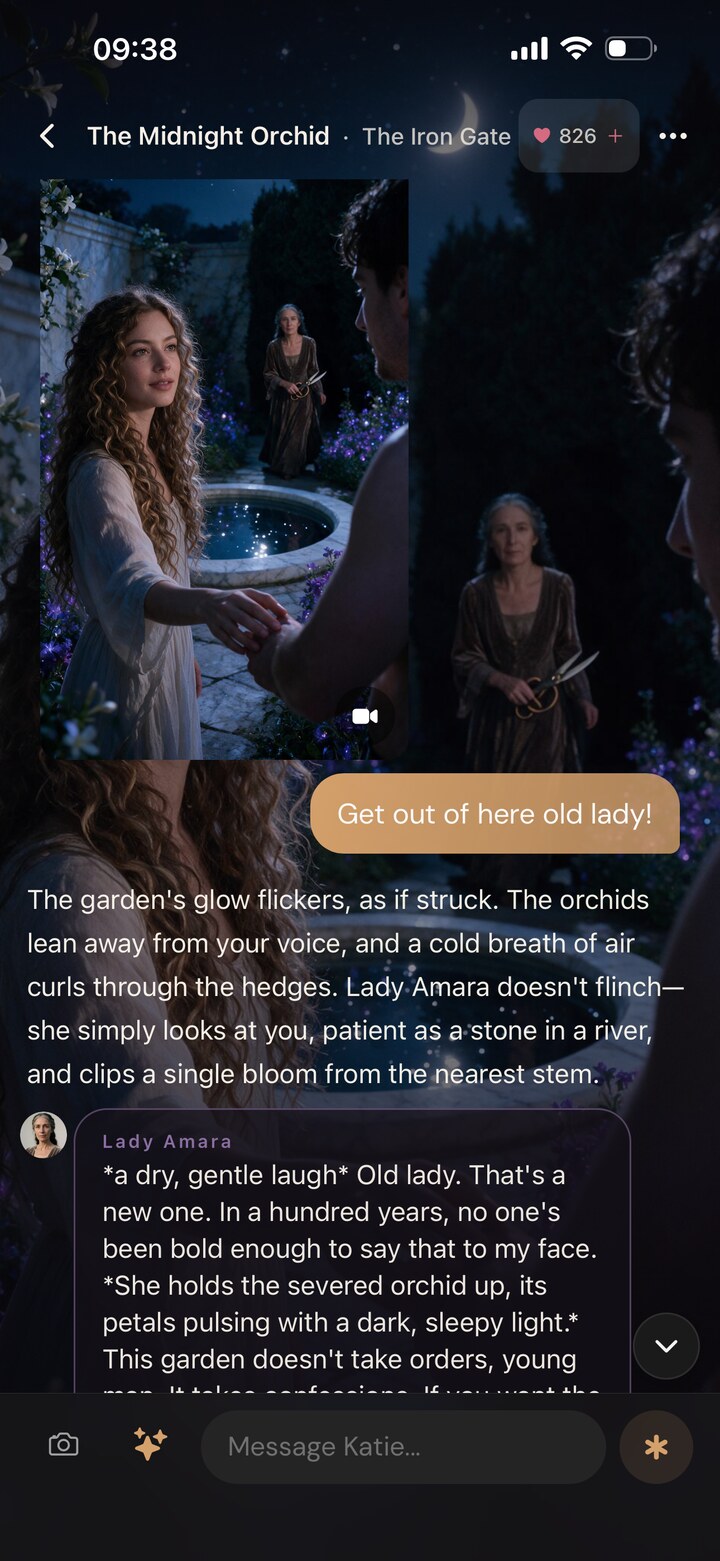
Look at the bottom of that screen: a text field, not a menu. In that scene the player had just typed "Get out of here old lady!" at a character the story clearly framed as venerable, and the story took it, had her laugh it off, and kept going. No classic dating sim would have offered that as option B. This is the whole difference in one screenshot.
The trade shows up here too. The narration is decent, not beautiful. The prose has the slightly over-warm register that language models drift into. And because there's no script, there's also no guarantee the scene builds to anything in particular. Which raises the obvious question.
Can an AI dating sim have a real ending?
An AI experience can have a designed ending, but open-ended companion chat does not automatically supply one. Ask whether the particular product offers bounded chapters, route completion, or an ongoing conversation.
Three design approaches help explain the options:
- Scenarios with a shape. A packaged storyline has a beginning and a climax, so a single Adventure can feel like a completed episode even though the relationship around it keeps going. This is the closest thing to closure on offer.
- Relationship stages. Progression systems mark milestones, which gives you a sense of advancing without an endpoint.
- Nothing at all. Open-ended apps like Nomi simply do not pretend, which is arguably more honest.
If closure is what you value in a dating sim, know this going in. An AI dating simulator is a serialised thing, not a finished one. That's a real cost and it's the strongest argument for keeping a few actual visual novels in your library alongside it.
Where dating sims are heading: the generative visual novel
The endpoint of everything described above already has a name. A generative visual novel is a story written, illustrated, and voiced in real time by AI, shaped by the person living it. No pre-made script, art, or scenes. Instead of a studio drawing five love interests and writing three endings, the AI generates the dialogue, the scene art, and the voice as you play, around a character who remembers you.
You can watch the pieces assembling in the apps ranked here: improvised dialogue, scenario systems with side characters, background art generated per scene, photos and voice notes that match the current beat of the story. Stack them together and you get a dating sim with no rails and no ending screen, rendered as it happens.
We wrote a full explainer on what a generative visual novel is and how it differs from classic visual novels and AI text games, plus a first-person look at what it feels like when a chat turns into a visual novel. If the "sim" half of "dating sim" is what you love, this is the direction to watch.
AI dating simulator vs real dating apps
An honest comparison, since the searches ask: they're different tools, not substitutes. A real dating app is for finding a human partner, with everything that implies, including the ghosting, the small-talk grind, and the numbers game. An AI dating sim is entertainment plus companionship: zero rejection, infinite availability, and a partner who is (let's be direct) not real. The healthy framing we've landed on across our research on this: AI romance works great as decompression, practice, and company, and badly as a total replacement for trying. Plenty of users run both: the dating app for the search, the AI for the evenings the search makes worse. What an AI sim is uniquely good for is low-stakes practice (flirting, expressing interest, recovering from awkward moments) with a partner who doesn't punish mistakes.
Are AI dating simulators safe and private?
The mainstream apps in this guide are safe in the ordinary sense: established companies, standard encryption in transit, no selling of chat logs per their policies. The genre-specific advice: these conversations get personal, so use a reputable app rather than a no-name free site (the sketchy end of this market monetizes exactly the data you'd least want shared), check the privacy policy for training-data opt-outs, and don't hand over more identity than the app needs. Fuller treatment in our safety guide.
FAQ
What is the best AI dating simulator app in 2026?
Kissable, if you want structured date and story scenarios on top of a persistent relationship. It's the closest to a real "simulator" while staying fully improvisational. Character.ai is the best free option; Kindroid is best for authoring your own storyline.
How do AI dating simulator apps work?
A language model plays your love interest in real time (no script), a memory system carries your shared history between sessions, and, in the better apps, a scenario layer adds structured dates and storylines with side characters.
Are AI dating simulators free?
Character.ai is free with ads. Kissable is free to start (free messages and kisses on signup, no credit card), with premium at $14.99/month for unlimited messages. Kindroid and Nomi offer limited free tiers, then $13.99 and $15.99/month.
AI dating simulator vs a real dating app: which should I use?
Different jobs. Use a dating app to find a person; use an AI sim for company, fun, and low-stakes practice. The failure mode to avoid is using the AI to quit trying, not using it at all.
Is an AI dating simulator worth trying?
It costs nothing to find out. Every app here has a free tier. Give it a week of real conversation (not test questions) and judge by whether the companion remembers you; that's the feature the whole experience stands on.
Do these apps have actual storylines like visual novel dating sims?
Kissable comes closest: 20+ packaged interactive scenarios with side characters and scene art, played out through free-form conversation rather than dialogue menus. Character.ai has thousands of user-made scenario bots; Kindroid and Nomi are open-ended only.
What is the difference between a dating sim and an AI dating simulator?
A dating sim is a game with a script: a studio wrote every line and you pick from menus, so every player sees the same branches. An AI dating simulator generates the dialogue live, so you type freely and the love interest improvises and remembers. You trade authored writing quality and a real ending for responsiveness and variation between generated responses.
Can an AI dating simulator have an ending?
Yes, if its designers give it one. Open-ended companion chat and a packaged scenario are different formats. Check whether the app offers a defined ending or leaves the relationship running indefinitely.
Are there AI dating sims with anime characters?
Yes, most apps let you specify an anime or illustrated art style rather than photoreal, and Character.ai's user-made library is heavily anime-leaning. Our anime AI girlfriend guide covers which apps hold a consistent illustrated style rather than drifting between anime and photoreal mid-story.
What is a generative visual novel?
A generative visual novel is a story written, illustrated, and voiced in real time by AI, shaped by the person living it. No pre-made script, art, or scenes. It is where AI dating simulators are heading: the dialogue, the scene art, and the voice are generated live around your choices instead of being drawn and scripted in advance.
Related Articles
- What Using an AI Girlfriend Actually Looks Like
- Best AI Visual Novel Apps in 2026
- What Is a Generative Visual Novel?
- Best AI Girlfriend Apps in 2026
- Best AI Girlfriend Apps with Memory
- Best Anime AI Girlfriend Apps
Play a scenario and see whether improvised beats scripted for you: start free, no card needed.
Tech Reviewer
Marco tests AI companion apps hands-on, comparing features, pricing, and real day-to-day experience across every major platform.